
How do I decompress my spine?
Gravity Stretching Method Team
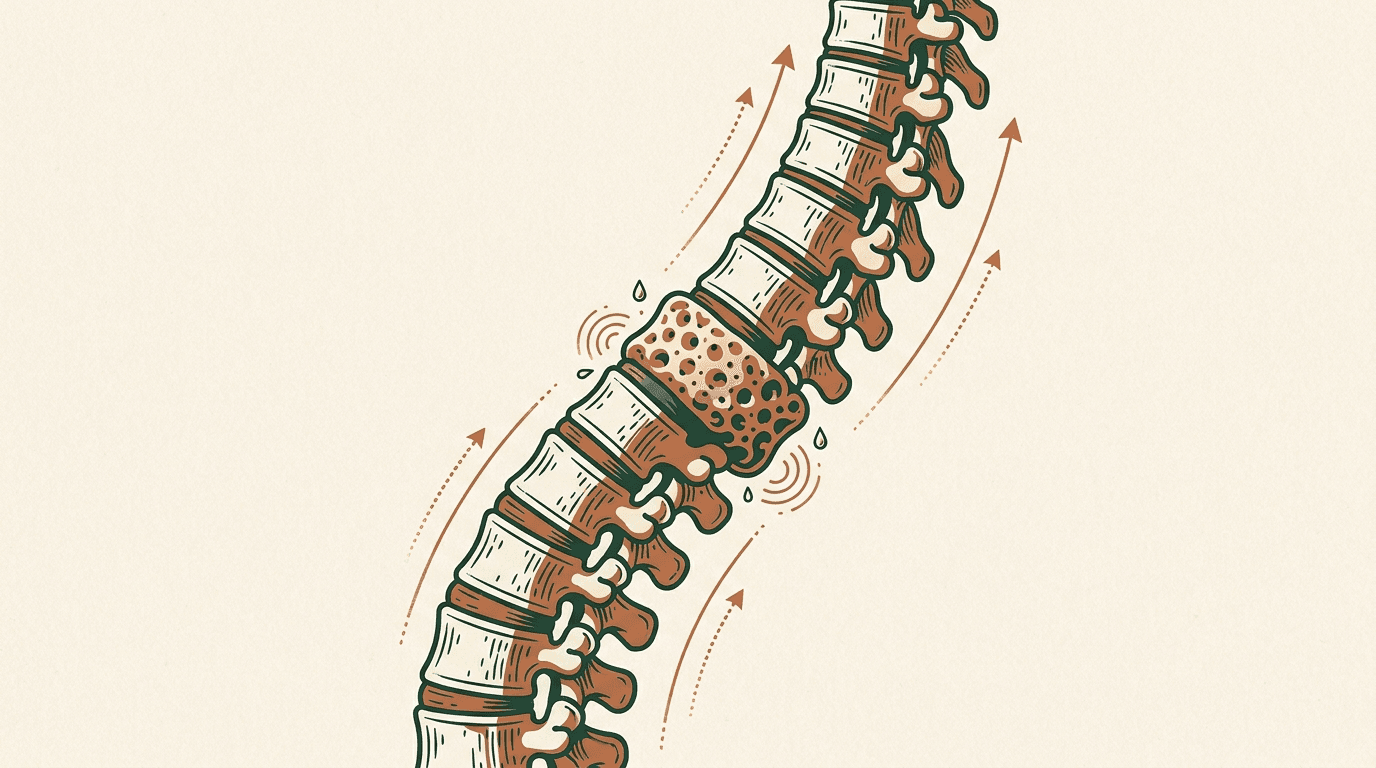
If you are searching for how to decompress your spine, your back has probably been asking for it for a while: that heavy, squeezed feeling by evening, the urge to stretch tall and make room between the vertebrae. To decompress the spine simply means to take the pressure off it for a while, so the discs can drink up and come back to life. Gravity presses us down all day long - it is the quiet price we pay for walking upright. Add hours in a chair, and the spine spends ten or twelve hours under load without a single minute of release.
The good news is that the body knows how to recover - it just rarely gets the chance. Watch any animal climb out of its den: the first thing it does is stretch. People forget. We jump up, grab the phone and run.
What decompression gives the discs
Picture an intervertebral disc as a kitchen sponge full of moisture. Keep it pressed all day and the moisture squeezes out - the disc flattens and loses its spring; there is even a term for it, disc dehydration. Give it space, and it soaks up fluid again and plumps back. That is all decompression is: decompression of the body creates space and takes the pressure off. Nothing mystical - for a little while you simply reverse the direction the load has been travelling all day.
And it is never only about the discs. When the spine gets room, the muscles around it stop bracing, breathing gets deeper, and the whole body feels lighter - not just the back.
Home methods - and their limits
There are honest ways to give the spine some relief at home. Lying flat takes most of the vertical load off, though it does not lengthen anything. Slow cat-cow movements and a soft child's pose gently open the spaces between the vertebrae. Hanging from a pull-up bar is real traction - but your grip gives out in twenty or thirty seconds, and while you fight to hold on, your shoulders and back are working hard, not releasing. Inversion tables tip you upside down, which is a lot for an unprepared body all at once.
Every one of these helps a little, and a little is already good. The catch is the same everywhere: as long as you hold on with effort, the nervous system keeps standing guard - and a guarded muscle does not let go.
The real secret: relaxation instead of effort
Here is the paradox of traction: the spine only lengthens when the muscles around it stop holding it. This is not the fitness idea of pushing harder - it is the opposite. The stretch has to feel fully supported. When the lianas carry all of your weight, the nervous system finally goes off duty, and the body opens on its own. So the best decompression happens while you rest inside the stretch: slow breathing, long exhales, no ambition. We are not here to exhaust the body - we are here to improve it.
How Gravity Stretching helps
Gravity Stretching is a therapy of gentle decompression on lianas: leg straps and finger loops carry your weight, so your grip never has to. You hang supported, and the same gravity that pressed you down all day starts to stretch you instead - decompression of the body creates space and takes the pressure off, millimetre by millimetre, while you simply breathe. A trainer stays beside you, everything starts small - a few seconds at a time - and nothing ever goes through pain. The first time, the body is usually surprised; by the third repeat it starts to trust and release.
Relief is usually felt after the very first session, pain tends to ease around session 4-6, and a stable result settles in around ten - a couple of sessions to lock it in, a few more so it does not come back. Regularity matters more than intensity. If you want to feel what a real supported hang does for your spine, find a studio near you - and if there is no studio in your city yet, vote for your city: that is exactly how we choose where to open next.
Part of our guide on Lower back pain
Feel it for yourself at a Gravity Stretching studio
General wellness information. Listen to your body: if a pain is sharp or shooting, do not force it - tell your trainer in advance and start even softer.
Related questions
People also ask
Ask your question
Describe what you feel. We answer real questions from people around the world.