
Can hanging fix sciatica?
Gravity Stretching Method Team
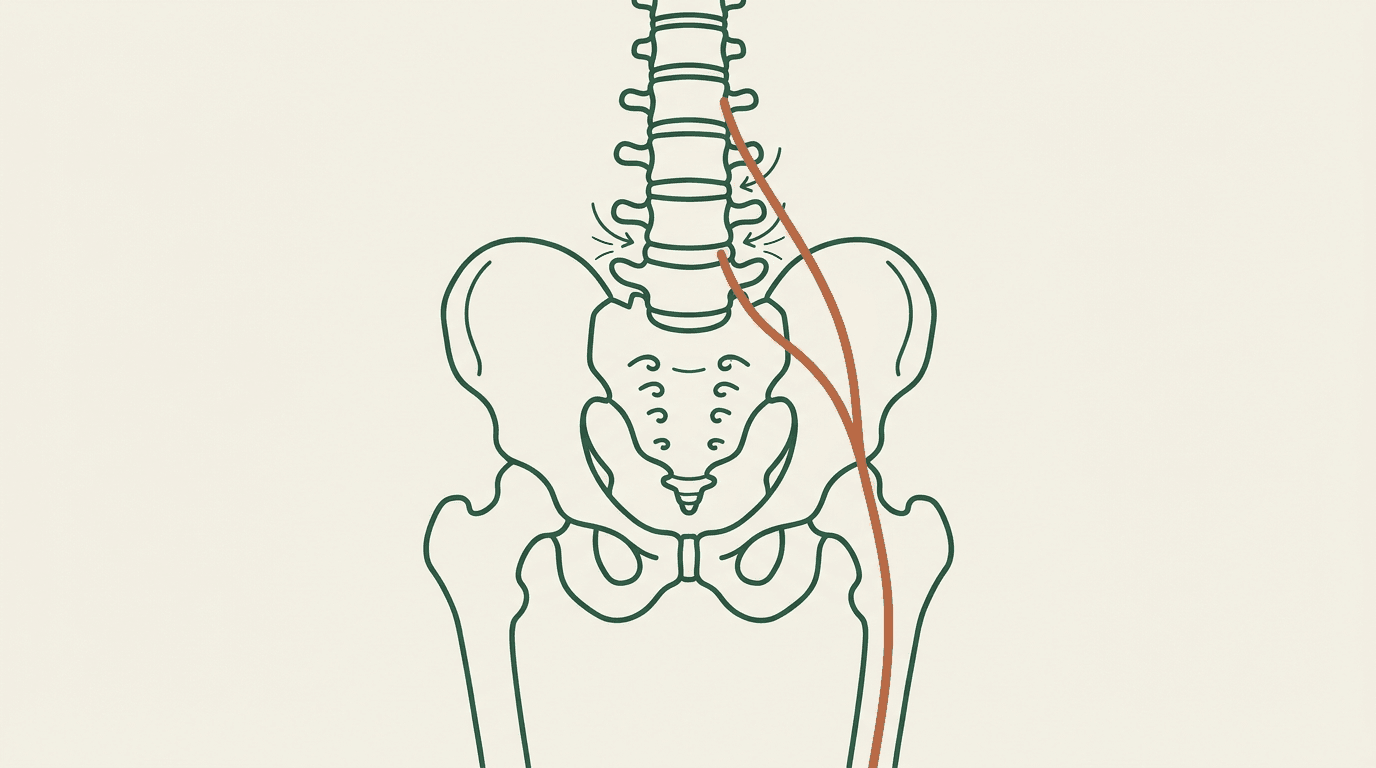
Can hanging fix sciatica? The honest answer is yes and no, and the whole story lives in the gap between the two. Hanging can genuinely ease sciatica - often the same day - because it works right on the thing underneath the pain: a nerve low in your spine that has run out of room. What one hang does not do is fix sciatica for good, the way a single good night of sleep does not fix being tired forever. Sciatica flares from a space that has closed in around the nerve, and hanging opens that space back up. Turn that opening from a one-off into a habit, and "relief" slowly becomes something much closer to a fix.
What "fixing" sciatica really means
Here is the trap most people fall into. They want sciatica gone in one move - one stretch, one hang, one appointment - and when the pain creeps back a few hours later, they decide hanging "did not work." But sciatica was never a one-move problem. That hot, shooting line down through the buttock and the back of the leg shows up because the nerve got squeezed where it leaves the lower back: a tight disc, a stiff joint, and hours of sitting pressing everything together until there is no room left.
So fixing it is not about forcing the pain to vanish. It is about giving the nerve back its space, and then keeping it there long enough that the body stops closing in on it. A fix is a direction, not a single moment - and hanging happens to point in exactly the right direction.
Why one hang relieves but a habit fixes
Hang from your hands and let the lower body drop, and the spine lengthens with nothing pressing down on it. Decompression of the body creates space and takes the pressure off, and the squeeze around the irritated nerve eases - that is the relief, and it is real. An intervertebral disc is like a kitchen sponge full of moisture: a day of sitting flattens it, and a hang gives it room to soak the fluid back up and lift the vertebrae apart.
But then you sit back down, and the load that closed the space in the first place goes right back to work. That is why a single hang relieves without fixing - the room you opened quietly closes again. The thing that turns relief into a fix is repetition: open that space a little, often, and the body slowly relearns how to hold room around the nerve on its own. Regularity matters far more than intensity here. Not one heroic hang, but many calm ones.
Why a pull-up bar can backfire
Reaching for a bar is the right instinct, but the bar rarely fixes sciatica, and sometimes it makes an angry nerve angrier. Grip gives out in twenty or thirty seconds - long before the lower back has released - and while you fight to hold on, the whole body braces hard. That bracing is the opposite of what an irritated nerve needs. Worse, a cold hang drops your full weight onto an unwarmed, already-guarding body, and that jolt can land right on the spot that hurts.
And there is a deeper mismatch. Fixing sciatica asks for length held long and calm; a bar gives you a short, strenuous burst. The nervous system reads all that effort as danger and keeps standing guard - and a guarded muscle never lets go. You get a workout, when the nerve wanted a rest.
Being honest about what a fix looks like
One rule with sciatica, always: never chase the pain. If a position sharpens that shooting line down the leg, that is your body saying stop - you ease off, breathe, and come back gentler. Relief comes from softening around the nerve, never from forcing through it. Listen to your body here; it does not lie to you, and it will tell you the difference between a good stretch and a warning.
And be honest about the timeline, so you do not quit too early. You often feel lighter after the very first session, the pain tends to ease around session four to six, and a stable result usually settles in around ten - because that is how long it takes the body to make the new room its new normal. If you cannot picture being free of it yet, hold on to that word: yet.
How Gravity Stretching helps
Gravity Stretching is this hang turned into a calm, guided practice - a therapy of gentle decompression built for exactly this. On the lianas, with leg straps and finger loops carrying your weight, grip stops being the limit: you can stay in the hang for minutes, breathing slowly, while the lower spine lengthens and the space around the nerve opens. Relaxation instead of effort - the traction works while you rest inside it, and a trainer stays beside you, so the lianas carry all of your weight and nothing gets forced. We start small, three seconds at a time, ease off the moment anything sharpens, and work with the whole body, because the back and the hip that feed the nerve are all part of the same picture.
This is also what turns relief into an actual fix: a version of hanging calm and safe enough to repeat, week after week, until the space stays open on its own. Relief is often felt after the very first session, the pain tends to ease around session 4-6, and a stable result settles in around ten - regularity beats intensity every time. If sciatica has you afraid to sit or walk, give the nerve the version of hanging it can finally let go into: find a studio near you, or - if your city does not have one yet - vote for your city, and we will know where to open next.
Part of our guide on Sciatica
Feel it for yourself at a Gravity Stretching studio
General wellness information. Listen to your body: if a pain is sharp or shooting, do not force it - tell your trainer in advance and start even softer.
Related questions
People also ask
Ask your question
Describe what you feel. We answer real questions from people around the world.