
Is hanging good for spine health?
Gravity Stretching Method Team
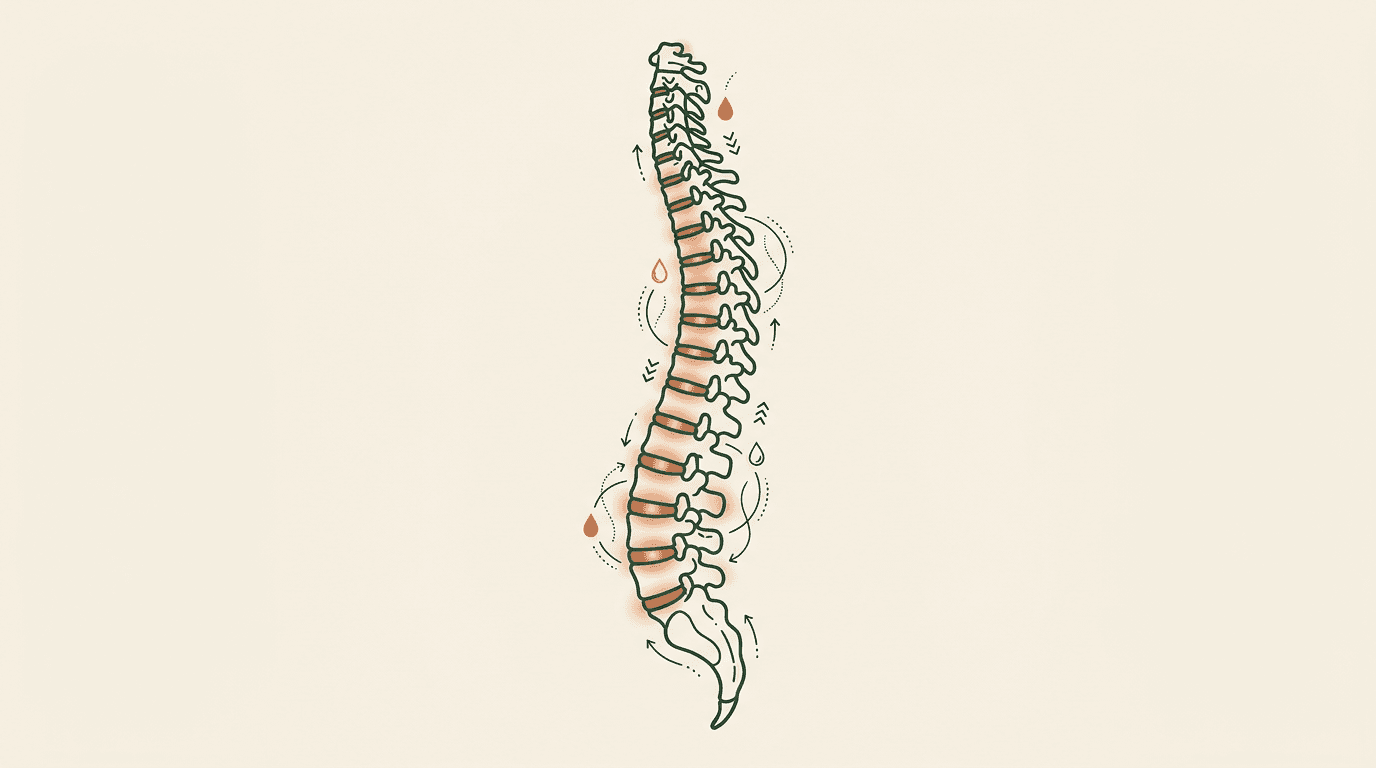
Is hanging good for spine health? For most people, yes - hanging for spine health does one simple thing the rest of the day never offers: it takes the steady downward load off the whole spine and lets it lengthen. From the moment you stand up, gravity presses you down, and hours of sitting pack the vertebrae closer together, top to bottom. A hang turns that around - the same gravity that compressed you all day becomes the force that gently stretches the spine back out. Done regularly and calmly, that daily unloading is one of the simplest things you can give a spine that spends most of its life compressed.
Spine health is the whole column, not one sore spot
When people say spine health they usually picture the lower back, but your spine is one long stack - neck, mid-back, low back - and every part of it lives under the same all-day load. It is a column of bones with soft, water-filled discs between them, and it spends the whole day holding you up. Sitting is the heaviest position of all: the pressure between the vertebrae is higher slumped in a chair than standing, so a desk day quietly packs the whole stack tighter. None of this is damage. It is just a body that got used to living under one constant load, with no moment in the day where the pressure comes off. A healthy spine is not a harder-squeezed one - it is one that gets to lengthen and move through its full range again.
What a hang gives the spine back
Hang from your hands and the spine gets to lengthen under its own weight, with nothing pressing down on it. Decompression of the body creates space and takes the pressure off: the vertebrae drift apart, the squeeze around the nerves eases, and the muscles that brace all day finally get permission to stand down. An intervertebral disc is like a kitchen sponge full of moisture - a day of load squeezes it flat, and the space of a hang lets it soak fluid back up. That is why people step down feeling taller and looser, less jammed. And the body remembers it: after a good hang it wants to live straight, walk straight, move straight. That is the real point of hanging for spine health - not a trick for one bad day, but a regular reminder to the whole column of how much room it is supposed to have.
How long, how often - and the thing that actually matters
The most common question is a number: how many seconds, how many sets, how many times a day. The honest answer is that the clock matters far less than whether you can relax while you hang. A spine only truly decompresses when the muscles around it let go, and they let go when the nervous system feels safe, not when you grit through another ten seconds. So the useful measure is not duration but ease: a calm hang where you breathe slowly and the back softens beats a tense one twice as long. Start small, a few seconds at a time, and let it build on its own. One place to be careful - spine health includes the neck, and the neck is the one part you never load with your body weight. It is built to carry a few kilos, not all of you. Let the hang lengthen the spine from the arms and the body, and keep the neck out of it.
Why a plain bar only gets you halfway
A pull-up bar looks like the obvious tool, but it rarely lets you reach the calm part. Grip gives out in twenty or thirty seconds, long before the spine has released, and while you cling on the shoulders ride up to the ears and the whole upper body works hard. The nervous system reads that effort as danger and keeps the muscles guarding, so the spine never really lets go - you get a grip workout, not decompression. A cold hang, full body weight dropped onto an unwarmed spine, can feel harsh enough to put people off the idea entirely. And on its own, a quick hang eases the pressure for a while but does nothing to teach the body to hold that length. The instinct to hang is right. The bare bar just fights it.
How Gravity Stretching helps
Gravity Stretching is this hang turned into a calm, guided practice - a therapy of gentle decompression for the whole spine. On the lianas, with leg straps and finger loops carrying your weight, grip stops being the limit: you hang for minutes, not seconds, breathing slowly while the spine drinks up the space. Relaxation instead of effort - the traction works while you rest inside it, a trainer stays beside you so the lianas carry all of your weight, and the height of the hang lets us aim the stretch at whichever part of the spine needs it, the neck kept safe and unloaded. We start small, three seconds at a time, and work with the whole body, not just the sore spot, so it is not only your spine that feels easier - the whole body does.
Relief is usually felt after the very first session, the pain tends to ease around session 4-6, and a stable result settles in around ten - regularity matters more than intensity. If your spine has been asking to hang from something, give it the version where it can actually let go: find a studio near you, or - if your city does not have one yet - vote for your city, and we will know where to open next.
Feel it for yourself at a Gravity Stretching studio
General wellness information. Listen to your body: if a pain is sharp or shooting, do not force it - tell your trainer in advance and start even softer.
Related questions
People also ask
Ask your question
Describe what you feel. We answer real questions from people around the world.